A UBO is the individual who ultimately owns or controls a company. Learn the meaning, definition, and how UBOs are identified in practice.

A UBO, or ultimate beneficial owner, is the individual who ultimately owns or controls a company, even when that ownership is not immediately visible.
The compliance world is full of acronyms such as KYC, KYB, AML, and UBO. Each plays a role in how businesses manage risk and carry out due diligence.
Among them, UBO, or ultimate beneficial owner, is one of the most important.
Understanding what a UBO is matters, especially for compliance, risk, and operations teams working across jurisdictions where ownership structures can be complex. This is where ultimate beneficial ownership software and verification becomes critical.
This guide covers five key things you need to know about UBOs.
Seeing is faster than reading.
Run a live KYB or UBO check on the free platform – no demo, no sales call.
What is a UBO? Understanding the Definition
A UBO, or ultimate beneficial owner, is the individual who ultimately owns or controls a company, even if that ownership sits behind multiple layers of entities.
In simple terms, a UBO is the person who:
- Directly or indirectly owns a significant share of a company
- Has influence or control over key decisions
- Benefits financially from the company’s activities
The Financial Action Task Force (FATF), the global standard-setter for anti-money laundering and counter-terrorist financing, defines a UBO as the natural person who ultimately owns or controls a customer, or the person on whose behalf a transaction is conducted.
While FATF provides a global definition, how UBOs are identified and reported can vary across jurisdictions.
In many regions, a common threshold used to identify a UBO is more than 25 percent ownership or control. This is applied in places such as the European Union, the United Kingdom, Singapore, and Hong Kong, as well as under the United States FinCEN framework, although the exact criteria can vary depending on local regulations.
While more than 25 percent is a common benchmark, UBO thresholds and definitions vary by jurisdiction and may also consider control, not just ownership.
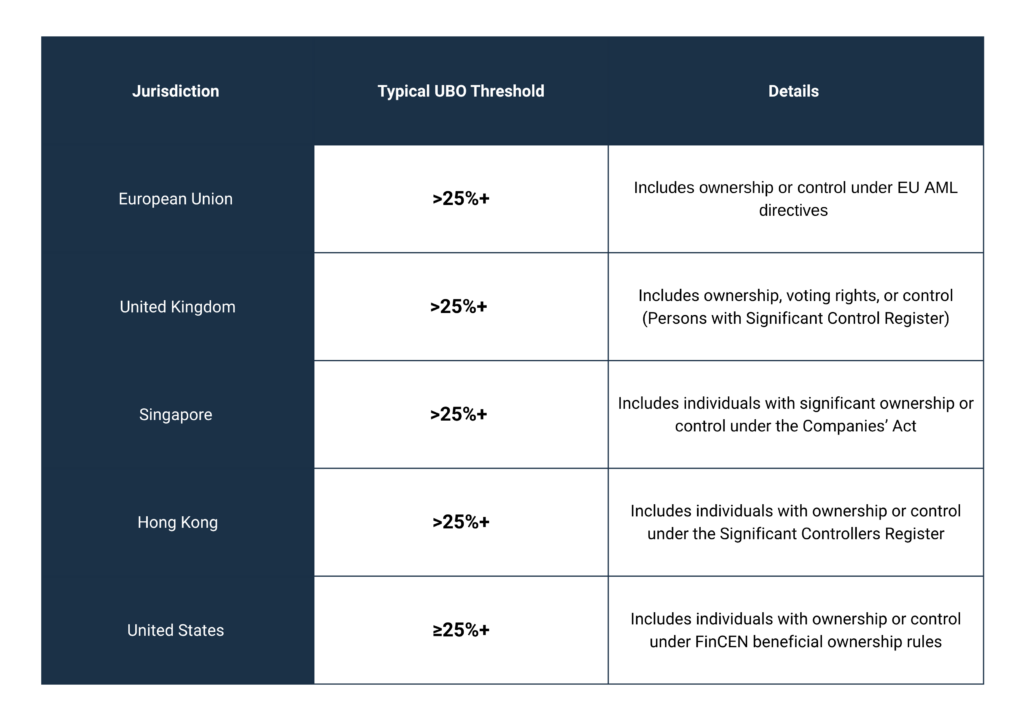
In practice, UBO identification is not limited to ownership percentage alone. Control, influence, and indirect ownership structures are also considered as part of UBO verification and compliance processes
What Does UBO Mean in Practice for Compliance and Risk Teams?
The meaning of UBO goes beyond what is listed on a company registry.
In practice, this is where things start to diverge from theory.
A registry might show a small number of shareholders, and on the surface, it looks straightforward. But once you start reviewing the structure, one of those shareholders could be another company registered in a different jurisdiction. That entity may then be owned by yet another company, and so on.
For compliance and risk teams, identifying the UBO means:
- Looking beyond the first layer of ownership
- Understanding who actually controls decisions
- Assessing whether any individuals present a risk
This matters because:
- Control can exist without direct ownership
- Ownership chains are not always transparent
- Risk sits with individuals, not just legal entities
A company may appear legitimate on paper, but the underlying owner could be linked to sanctions, political exposure, or financial crime.
This is why UBO identification sits at the centre of due diligence, anti-money laundering checks, and broader UBO verification and compliance processes.
How to Identify a UBO in Real Workflows?
Identifying a UBO is not a single step. It is a process of building a clear picture from incomplete information.
In practice, teams need to:
- Start with the company registry data to confirm legal details and known shareholders
- Trace ownership across entities to understand how control is structured
- Identify the individuals who ultimately meet ownership or control thresholds
- Cross-check information across multiple sources where data is incomplete or inconsistent
- Screen individuals for sanctions, political exposure, and adverse media
Where this becomes challenging is not the first step, but everything after it.
For example, a company in Hong Kong may list a corporate shareholder. That shareholder could be registered in another jurisdiction where little information is publicly available. At that point, teams need to decide whether to proceed, escalate, or request additional documentation.
This is where UBO identification becomes less about following a checklist and more about making informed decisions based on available data.
Why Identifying UBOs is Difficult, Especially Across Asia
While the definition of an ultimate beneficial owner is clear, identifying one accurately is often not.
Common challenges include:
- Layered ownership structures
Companies are frequently owned by other companies across jurisdictions, making it difficult to trace the individual at the top. - Fragmented registry data
Not all jurisdictions provide complete or consistent shareholder information. - Indirect control
Control may be exercised through agreements or influence rather than direct ownership. - Cross-border complexity
Different countries apply different definitions, thresholds, and reporting requirements. - Language and data barriers
Company records may only be available in local languages or formats.
For teams verifying companies across Asia, these challenges are not edge cases. They are part of day-to-day operations.
How Businesses Approach UBO Verification Today
Because of these challenges, identifying UBOs requires more than a basic registry check.
In practice, this means:
- Combining data from multiple official sources
- Mapping ownership structures across entities
- Identifying controlling individuals
- Screening for risk indicators such as sanctions and adverse media
- Monitoring changes over time
For many teams, this process is still manual, especially when dealing with cross-border entities. Information needs to be gathered, translated, and validated before a clear picture can be formed as part of ongoing UBO compliance.
AsiaVerify supports this by reconstructing ownership structures using registry-backed data and filings, helping teams identify controlling individuals even in complex, multi-layer structures.
What This Means for Your Due Diligence Process
Understanding what a UBO is is a fundamental part of modern due diligence.
In practice, the challenge is not defining beneficial ownership. It is building a reliable view of who actually sits behind a business, especially when data is fragmented across jurisdictions.
For compliance, risk, and operations teams, having a structured approach to UBO identification helps reduce uncertainty and supports more confident decision-making.
The data behind this guide is live and searchable.
Check any company across Asia – registry-backed, free to start.
Book a 20-min demo and see how AsiaVerify accelerates onboarding, reduces false positives, and keeps you audit-ready.