


Anti-Money Laundering (AML) Solution Real-Time AML Screening Solution for APAC
Streamline AML Compliance
with Real-Time Screening

Continuous Monitoring
Get immediate alerts for changes in status, ownership, or adverse news.

Direct Access to Registries
Tap trusted government data from 14 APAC markets, always current and translated.

Real-Time Data & Translation
Retrieve and understand documents fast, with built-in translation removing language barriers.

Flexible API Integration
Add AML screening to your workflows with an API designed to simplify and automate compliance.
How Our AML Solution Works Verified AML Data, Built for Compliance
This provides audit-ready trails and cross-border clarity, ensuring AML screening is accurate, up to date, and trusted.
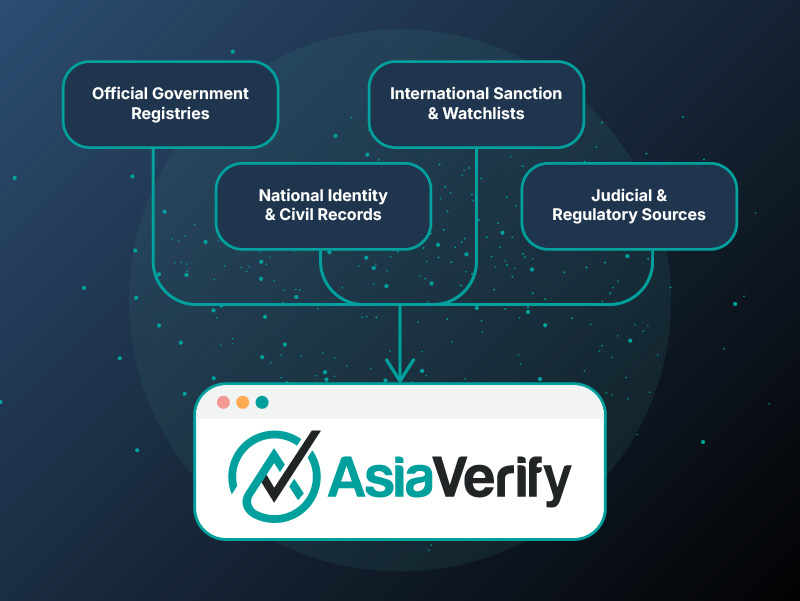
How Our AML Solution Works AI-Powered Structuring
The result is clean, actionable intelligence without manual reconciliation.

How Our AML Solution Works Flexible Delivery, Seamless Integration
Every option provides the same trusted AML data and watchlist intelligence, ready to plug into onboarding, due diligence, or monitoring processes.
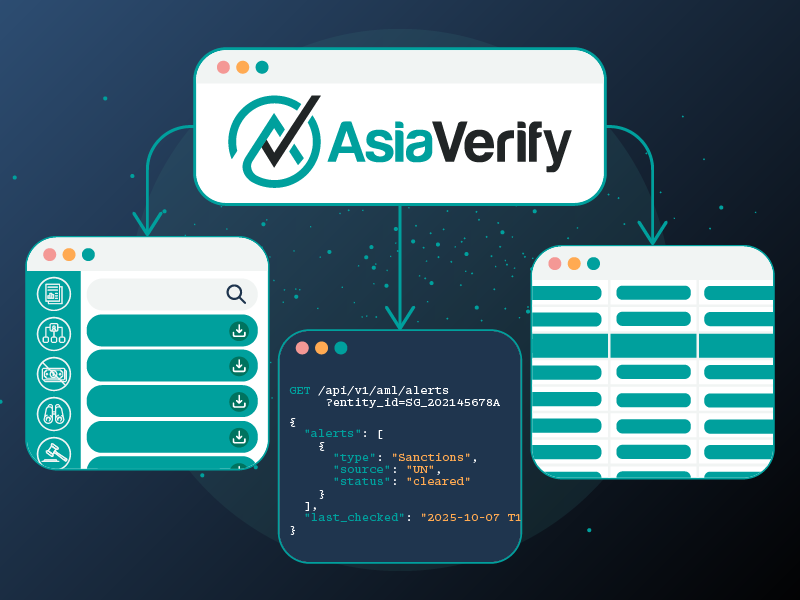

Confirm the AML data you need.
Built for Your Sector’s Risk, Speed & Standards An AML Compliance Solution That's Tailored to Your Industry
 Financial Service
Accelerate Onboarding and Stay Compliant
Financial Service
Accelerate Onboarding and Stay Compliant
Smarter Onboarding and Risk Management Across APAC
AsiaVerify connects financial institutions to real-time APAC registry data for KYB, UBO, and AML checks.
Onboard customers faster, detect hidden risks, and meet global and local regulatory standards with confidence.
 Legal & Professional Services
Make Confident Decisions Backed By Source Data
Legal & Professional Services
Make Confident Decisions Backed By Source Data
Simplify Due Diligence And Risk Analysis
Support audits, litigation, M&A, and advisory work with current, registry-backed intelligence on entities and ownership structures.
AsiaVerify delivers translated documents, verified corporate records, and defensible audit trails—without manual research.











With the help of AsiaVerify’s professional and helpful staff and simple API integration, it was seamlessly integrated on the ZignSec platform.

Insights and Guidance to Strengthen Your Compliance Strategy Anti-Money Laundering (AML) Resources
 Read more about Navigating the New Tariff Landscape: How Asian Supply Chains Are Evolving
Navigating the New Tariff Landscape: How Asian Supply Chains Are Evolving
Learn how changing tariffs are impacting supplier risk and reshaping trade across Asia
 Read more about How to Verify a Company in Malaysia: A Practical Guide for Risk-Free Business Engagement
How to Verify a Company in Malaysia: A Practical Guide for Risk-Free Business Engagement
Follow this guide to run reliable KYB and UBO checks on Malaysian companies using official data
 Read more about The Changing Trade Landscape: Why Merchant Verification Matters More Than Ever in Asia
The Changing Trade Landscape: Why Merchant Verification Matters More Than Ever in Asia
Rising trade risk makes merchant verification a must for compliant onboarding in Asia
 Read more about Why UK Companies Must Strengthen Compliance in Asia
Why UK Companies Must Strengthen Compliance in Asia
UK firms need stronger oversight to manage evolving compliance risks across Asia
Ready to See Our AML Solution in Action? Book a Quick Demo
AML FAQs
What is anti-money laundering (AML)?
Anti-money laundering — AML — refers to the laws, regulations, and operational processes that financial institutions and businesses must maintain to detect, prevent, and report money laundering and related financial crime. AML compliance is a legal obligation across most regulated industries: banking, payments, insurance, capital markets, and increasingly, cryptocurrency exchanges and corporate onboarding platforms. An effective AML programme combines identity verification, transaction monitoring, sanctions screening, and risk assessment into a continuous compliance workflow — not a single point-in-time check.
What is money laundering?
Money laundering is the process by which criminals disguise the origins of illegally obtained funds to make them appear legitimate. The term originates from organised crime’s use of cash-intensive businesses — laundries among them — to mix criminal proceeds with genuine revenue. Today it encompasses far more sophisticated methods: shell companies, trade-based manipulation, real estate transactions, and digital assets. Money laundering is illegal in virtually every jurisdiction and is a predicate offence connected to drug trafficking, fraud, corruption, and terrorism financing. Globally, the United Nations estimates that between two and five per cent of global GDP is laundered each year.
What is AML compliance?
AML compliance refers to an organisation’s adherence to the regulatory obligations requiring them to detect, prevent, and report money laundering. A compliant AML programme typically includes a formal risk assessment, written policies and procedures, a designated Money Laundering Reporting Officer (MLRO), staff training, customer due diligence processes, transaction monitoring, and mechanisms for filing Suspicious Activity Reports (SARs) with the relevant financial intelligence unit. Regulators expect AML programmes to be risk-based — meaning the depth of controls applied to any customer or transaction should reflect the actual risk that customer or transaction represents. Blanket, tick-box approaches are increasingly penalised by regulators who expect demonstrable, proportionate risk management.
What are AML checks?
AML checks are the specific screenings applied to individuals and entities as part of an AML compliance programme. They typically include sanctions and watchlist screening — checking the subject against global enforcement lists such as OFAC, the UN consolidated list, and the EU sanctions register — negative media screening, which surfaces news coverage associating the subject with financial crime or corruption, and PEP screening, which identifies individuals who hold or have held prominent public positions and are therefore considered higher risk. AML checks can be applied to both individuals and companies, though PEP screening is specific to individuals. A single AML check can run all three categories simultaneously, returning a structured result that compliance teams can adjudicate.
What is sanctions screening in AML?
Sanctions screening is the process of checking an individual or entity against official sanctions lists — government and intergovernmental registers of persons, organisations, and countries subject to financial restrictions. Major lists include those maintained by OFAC (US), the UN Security Council, the European Union, and the UK Office of Financial Sanctions Implementation. Regulated entities are legally prohibited from conducting business with sanctioned parties, and failure to screen adequately can result in significant regulatory penalties. Sanctions screening should be applied at onboarding and repeated on an ongoing basis, because lists are updated frequently and a subject’s status can change after the initial check.
What is a suspicious transaction in AML?
A suspicious transaction is any financial activity that is inconsistent with a customer’s known profile, business activity, or expected behaviour — and which may indicate money laundering, fraud, or another financial crime. Red flags include large cash transactions with no clear business purpose, structuring of deposits to avoid reporting thresholds (a practice known as smurfing), transactions involving high-risk jurisdictions without a credible explanation, rapid movement of funds through multiple accounts, and mismatches between declared business activity and actual transaction patterns. When a suspicious transaction is identified, regulated entities are typically required to file a Suspicious Activity Report (SAR) with the relevant financial intelligence authority.
What is smurfing in money laundering?
Smurfing — also called structuring — is a money laundering technique in which large sums of illicit cash are broken into smaller amounts and deposited across multiple accounts, often by multiple individuals, to avoid triggering the reporting thresholds that apply to large cash transactions. It is most commonly associated with the placement stage of the money laundering process. Smurfing is itself a criminal offence in most jurisdictions, regardless of whether the underlying funds are proven to be illicit. It is also one of the more detectable forms of money laundering precisely because the pattern of structured deposits creates a recognisable transaction signature that AML monitoring systems are specifically designed to flag.
What is name screening in AML?
Name screening is the process of matching an individual or entity’s name against sanctions lists, PEP databases, watchlists, and adverse media sources to identify potential risk. It is a core component of both onboarding due diligence and ongoing monitoring. Name screening is more complex than it appears: common names generate significant false positives, transliterated names from Chinese, Japanese, or Arabic scripts create matching challenges, and aliases or spelling variations can cause genuine hits to be missed. Effective name screening uses fuzzy matching logic, supports multiple scripts and languages, and allows for optional inputs such as date of birth or country to narrow results and reduce false positives. For businesses operating across Asia, multilingual name screening capability is not optional — it is a baseline requirement.
How does AML software work?
AML software automates the screening, monitoring, and reporting processes that manual compliance teams cannot perform at scale. It works by querying sanctions lists, PEP databases, and adverse media sources against submitted individual or entity data, applying configurable matching logic, and returning structured results that compliance teams can review and adjudicate. More advanced AML platforms layer transaction monitoring on top of screening — analysing patterns of financial behaviour to identify anomalies that may indicate layering or integration activity. For businesses operating across Asia, the key differentiator between AML solutions is data quality and language support. Screening a Chinese or Japanese name requires the system to search both the original-language name and its English translation to avoid missing genuine hits. AsiaVerify’s AML screening covers Watchlists and Sanctions, Negative Media, and PEP checks for individuals, and Watchlists and Negative Media for companies — with full support for English, Chinese, and Japanese inputs.
How can businesses prevent money laundering?
Preventing money laundering requires a risk-based compliance programme that addresses each stage of the money laundering process. At onboarding, robust KYC and AML screening establishes who the customer is and whether they present any immediate risk. During the relationship, transaction monitoring identifies behavioural anomalies that may indicate layering or integration. Ongoing monitoring — re-screening customers against updated sanctions and PEP lists — ensures that risk status changes after onboarding are detected promptly. Businesses operating across multiple jurisdictions face additional complexity: each market has its own regulatory framework, identity data infrastructure, and risk profile. A unified platform that handles KYC, AML screening, and ongoing monitoring across all relevant markets through a single integration is significantly more effective than managing separate point solutions by country.